
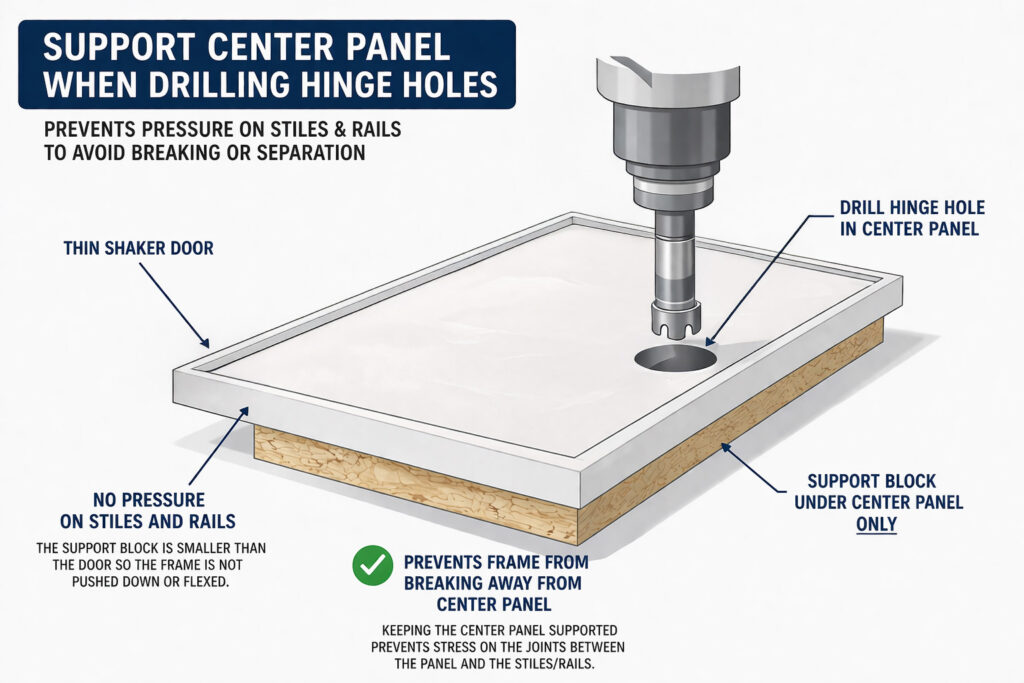
When drilling hinge holes on a thin shaker door, it is important to support the center panel only. This helps prevent pressure from being transferred to the stiles and rails, which can lead to cracking, separation, or damage at the joint where the frame meets the panel.
Place a support block underneath the center panel, making sure the block is smaller than the overall door so it does not touch or lift the surrounding frame. The stiles and rails should remain unsupported and free from downward pressure. This setup keeps the center panel stable while avoiding stress on the outer frame.
Once the door is positioned correctly, drill the hinge hole in the center panel area as needed. Because the center panel is backed up from below, the drilling force is absorbed through the supported section instead of pushing against the frame. This reduces the chance of the frame breaking away from the center panel during machining or manual drilling.
Do not place a full-size board under the entire door. Supporting the whole door can push upward on the stiles and rails and create flex or pressure in the wrong areas. The goal is to support only the center section while keeping the frame relaxed.
Using this method helps protect the door construction, reduces the risk of joint failure, and provides a safer, more consistent way to drill hinge holes on thin shaker doors.
Share your suggestions below and help us make the NYDD experience even better.
Thank you for helping us build better.